








Your naira savings and current account can’t be used to send money abroad or receive foreign currencies. What you need is a domiciliary account.
A domiciliary account, often called a “dom account,” lets you hold funds in multiple fiat currencies like USD, GBP, EUR, and more inside your local banking system, receive international transfers, and make eligible cross‑border payments.
In this post, you’ll learn about the benefits and drawbacks of domiciliary accounts, the currencies you can hold, and steps to open one seamlessly.
What Is a Domiciliary Account?

A domiciliary account is a bank account that allows you to hold and transact in foreign currencies such as US dollars, British pounds, and euros.
In Nigeria, it is commonly used to receive eligible foreign currency payments, hold foreign funds, and carry out certain international transactions.
The currencies you can hold depend on the bank and account type, with USD, GBP, EUR, and Chinese yuan (YUAN) among the most common options. For instance, having a dollar account is like owning a domiciliary account in US dollars. Having a domiciliary account is very useful if you regularly deal with foreign currency.
How Does a Domiciliary Account Work?
A domiciliary account works by funding it with your preferred currency through options like cash deposits or foreign transfers.
Once the account is funded, you can withdraw, transfer, or spend directly in that currency. Some banks let you link the account to a debit card for foreign transactions, while others require you to visit a branch or use internet banking for withdrawals and transfers.
Requirements for a Domiciliary Account in Nigeria
The requirements for opening a domiciliary account vary with Nigerian banks. However, you will typically need to provide identification and other information required for KYC (Know Your Customer) verification.
Requirements may include:
- A valid means of identification
- BVN and NIN details where applicable
- Passport photograph
- 2 references
- Proof of address where required
- Completed account-opening forms
- Valid ID of each signatory
- Residence Permit (Foreigners)
- Certificate of Incorporation / Business Registration
- Memorandum and Articles of Association as applicable, among others.
Before applying for a domiciliary account, check the current requirements of the bank you want to use, as its documentation and verification process may differ from another bank.
Charges on a Domiciliary Account to Watch Out For
Depending on your bank and the transaction, you may encounter charges when receiving or sending foreign currency, withdrawing funds, converting currencies, or using certain banking services.
Some charges to look out for may include:
- Foreign-currency transfer fees
- Withdrawal charges
- Opening balance
- Annual maintenance
- Card maintenance
- Currency conversion costs
- Correspondent or intermediary bank charges
Overall, the exact charges depend on the bank, currency, type of domiciliary account, and transaction.
How to Fund a Domiciliary Account in Nigeria
How you can fund a domiciliary account depends on the bank, the currency, and the type of transaction involved. Depending on the available banking options, you may be able to fund your account through:
- In-bank local-foreign conversion (very scarce option)
- Foreign-currency transfers.
- Foreign-currency cash deposits.
While a domiciliary account gives you a conventional way to hold foreign currency, these requirements, charges, and restrictions can become less convenient when most of your financial activity happens online.
How to Open a Domiciliary Account in Nigeria: Step-by-Step
Opening a domiciliary account isn’t necessarily difficult, but the process can involve more documentation and banking requirements than people expect. Here’s how it typically works.
Step 1: Choose Your Preferred Bank and Foreign Currency
Start by picking a bank that offers domiciliary accounts and decide which currency you need. Some banks offer better rates or lower fees depending on the currency, so it’s worth comparing a few options first.
Step 2: Check the Bank’s Requirements
Every bank has its own conditions for opening a domiciliary account. These can include a minimum opening balance, proof of income, or specific account tiers. Checking this ahead of time saves you a wasted trip or a stalled application.
Step 3: Complete the Account-Opening Process
You’ll need to fill out an account opening form, either online or in person, depending on what the bank supports. Some banks now allow you to start this process digitally before finishing verification at a branch.
Step 4: Submit Identification and Required KYC Documents
You’ll typically need a valid ID, proof of address, and passport photographs. Some banks may also ask for a reference or additional documentation, depending on their internal policy.
Step 5: Fund the Account
Once your account is approved, you can fund it through a foreign currency deposit, an international transfer, or by converting naira at the bank’s exchange rate.
Step 6: Activate and Start Using the Account
After funding, your account becomes active, and you can start transacting, whether that’s saving, transferring funds, or spending abroad, depending on the features your bank provides.
What Are the Benefits of a Domiciliary Account?
1. Receive Certain Foreign Currency Payments
A domiciliary account allows you to receive foreign currency payments and transfers, depending on your bank and the type of transaction. This can be useful if you work with international clients, receive money from abroad, or regularly deal with foreign-currency payments.
2. Useful for International Transactions
A domiciliary account supports eligible foreign currency transactions, including certain international transfers and payments. This is especially useful for business owners who import goods or anyone who sends money to family living outside Nigeria
3. Useful for Travel and International Expenses
If you regularly travel outside Nigeria or have expenses in foreign currencies, having a domiciliary account can be useful. It allows you to set money aside in the currency you’ll actually spend it in. Instead of converting naira at the airport or looking for dollars before a trip, you already have foreign currency in your account.
Drawbacks of Using a Domiciliary Account in Nigeria
1. More Documentation Requirements
Opening a domiciliary account isn’t always as straightforward as opening a regular digital account. For most banks, you may need to provide referees, identification, personal information, and other documents before the account is activated.
The exact requirements vary by bank, but this additional paperwork can feel cumbersome if you simply need a convenient way to manage foreign currency digitally.
2. Funding Limitations
If you want to fund your domiciliary account in Nigeria, you need to fund it with foreign currencies in cash. This means you may have to go to a Bureau de Change operator to convert your naira to any foreign currency of your choice. Then go to your bank to deposit the cash into your domiciliary account. This can become inconvenient.
3. High Bank and Transaction Charges
The cost of using a domiciliary account goes beyond a possible account maintenance fee. Depending on the bank and transaction, you may encounter charges for transfers, withdrawals, currency conversion, or correspondent and intermediary banking services.
These costs can matter if you frequently receive, move, convert, or spend foreign currency.
4. Limited Spending Flexibility
Having dollars in a domiciliary account is one thing. Being able to use those dollars conveniently is another.
A foreign-currency balance doesn’t automatically mean you can pay for every international subscription, online service, or purchase. Your spending options depend on the bank’s available payment channels, cards, and transaction policies.
This is an important distinction for people who earn or hold USD primarily for digital and international spending.
5. Not for Low-Volume Digital Spenders
If you only need foreign currency for a one-time subscription or a little international purchase, a domiciliary account is not what you need. These accounts often come with minimum balance requirements, and some charge maintenance fees regardless of how often you use them. A virtual dollar card, like Pouchers virtual dollar card, is better for this kind of transaction.
Download the Pouchers mobile app to get your virtual dollar card and have a virtual foreign account.
Domiciliary Account vs Virtual Foreign Account: What is the Difference?
| Features | Nigeria Domiciliary Account | Virtual Foreign Account |
| Provider | Traditional banks | Digital financial platforms |
| Funding options | Cash deposit and transfer | Crypto, naira-to-foreign-currency conversion, transfer |
| Spending limitation | Up to $10,000 daily | Up to $50,000 daily |
| Card cost | $10 – $13.98 | $2 – $5 |
| Dollar card availability duration | Can take days to weeks to issue and activate | Immediately |
| Type of Dollar card issued | Physical and virtual dollar cards | Virtual cards |
| Opening balance fee | $20 – $10,000, depending on the type of domiciliary account | $0 |
| Transfer Charges | 0.25% – 0.50% of the amount you want to send. | 0.50% of the amount you want to send |
| Account maintenance fees | $10 – $20 | Free |
| Best suited for | people handling large, occasional transactions | Frequent digital spenders, freelancers, remote workers |
A Nigerian domiciliary account and a virtual foreign account can both help you manage foreign currency, but they serve different purposes. These differences include:
1. Funding Options
Funding options for a domiciliary account include foreign-currency transfers and foreign cash deposits. While a virtual foreign account funding includes international transfers and funding a wallet through supported local currency or stablecoins. For example, you can fund your Pouchers USD Wallet with USDT or USDC.
2. Charges
The cost of using either option depends on the provider and the transactions you make.
With a domiciliary account, you may encounter charges related to foreign-currency transfers, withdrawals, currency conversion, and card transactions. Whereas virtual foreign account charges can include card creation, monthly maintenance, funding, and cross-border fees.
For example, Pouchers virtual dollar card has a $2 one-time creation fee. Pouchers’ maintenance fee and funding fee are free.
3. Spending Limitations
The amount you can spend or transact with can differ significantly between a traditional domiciliary account and a virtual foreign account. A domiciliary account allows up to $10,000 in daily transactions, while a virtual foreign account can allow up to $50,000 daily.
4. Cost of Dollar Card
A domiciliary account may give you access to a foreign-currency card. Its dollar card can cost between $10 and $13.98, while a virtual dollar card for a virtual foreign account can be as low as $2.
5. Dollar Card Availability Duration
For a bank-issued dollar card, you may have to wait for some days or even weeks to collect it, but you can get your virtual dollar cards almost immediately on a platform like Pouchers
6. Target Users
The biggest difference may come down to who each option is designed to serve.
Traditional domiciliary account target users are people who
- Prefer traditional banking
- Mainly need to hold foreign currency
- Regularly receive eligible foreign-currency transfers
- Need conventional banking infrastructure
- Prefer keeping their foreign currency with a Nigerian bank
While a virtual foreign account targets users are people who:
- Work with international clients
- Earn money online
- Low-volume digital spenders
- Pay for international subscriptions
- Buy products from foreign websites
- Run digital advertising
- Travel and make international payments
- Want to manage foreign-currency transactions primarily from your phone
Pouchers: The Best Alternative to a Domiciliary Account
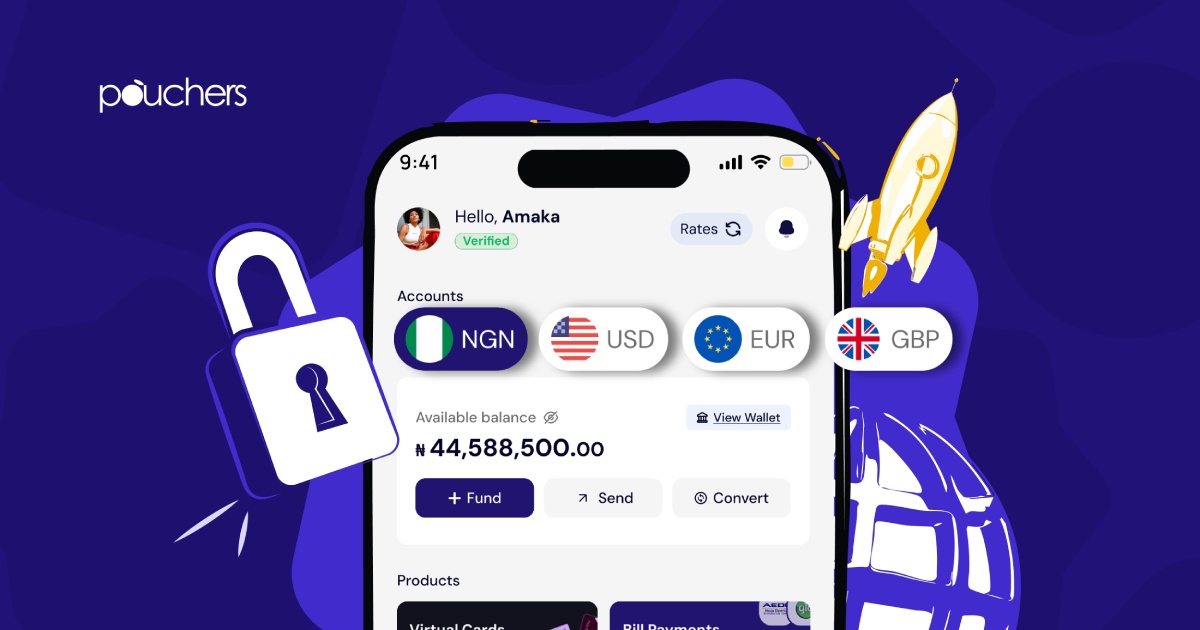
If your main reason for opening a domiciliary account is to receive, hold, and manage foreign currency, a traditional bank is not your only option. Pouchers offers a digital alternative that gives you access to USD, EUR, and GBP accounts backed by stablecoins, while making it easier to receive and manage international funds.
Ease of Currency Conversion
You can easily convert your naira to dollars, pounds, or euros on the platform without looking for a Bureau de Change Operator. Essentially, Pouchers converts currencies for free.
Different Methods of Funding
A major advantage of Pouchers is having more convenient ways to receive international payments. You can receive USD through ACH transfer, wire transfer, or FedNow, depending on the payment method available to the sender.
Ease of Use
Additionally, Pouchers lets you manage all your foreign-currency balances from one digital platform.
Funded with Stablecoins
Furthermore, you can create deposit addresses for USDT or USDC across different networks and receive stablecoins directly into your Pouchers account. Your Pouchers USD wallet can be funded through stablecoins.
All-in-one Platform
Pouchers offers free account maintenance, so you don’t have to pay a recurring fee simply to keep your account active. Pouchers also combines foreign-currency accounts, international payment rails, stablecoin deposits, currency conversion, and digital money management in one platform.
So, if you are looking for an alternative to a Nigerian domiciliary account because you need more than simply somewhere to keep dollars, Pouchers can provide a more digital way to manage your international finances.
Download the Pouchers mobile app to get your virtual dollar card and have a virtual foreign account.
Domiciliary Account vs. Virtual Foreign Account: Which Is Better?
A domiciliary account is tied to a traditional bank, so opening one can involve more documentation and, in some cases, a minimum balance.
A virtual foreign account, on the other hand, is built for speed and everyday digital spending. You can typically set one up in minutes, without branch visits or heavy paperwork, and use it right away for online subscriptions, shopping, or freelance payments. For people who spend foreign currency often but in smaller amounts, this tends to be the more practical option.
So which should you choose? If you need a long-term store of foreign currency or handle large international transactions, a domiciliary account still makes sense. But if your foreign currency needs are more frequent and digital-first, a virtual account gives you faster access with less friction.
Frequently Asked Questions
1. What are the charges on a domiciliary account?
The charges on a domiciliary account vary by bank, account type, currency, and transaction. Depending on the bank, you may encounter fees for foreign-currency transfers, withdrawals, currency conversion, card transactions, or correspondent and intermediary banking services. Check your bank’s current fee schedule for the exact charges that apply to your account.
2. Can I withdraw Naira from my domiciliary account?
Yes, you may be able to access the Naira value of funds in your domiciliary account, but this is generally a conversion rather than a direct Naira withdrawal.
3. Is a virtual foreign account the same as a domiciliary account?
No. A virtual foreign account is not the same as a traditional domiciliary account. A domiciliary account is a foreign-currency bank account provided by a conventional bank, while a virtual foreign account is a digital financial account designed to give you access to foreign-currency services through an online platform.
4. Is a domiciliary account better than a virtual foreign account?
The right option depends on how you use foreign currency. A domiciliary account may suit you if you primarily want to hold foreign currency and use traditional banking services, while a virtual foreign account may be more suitable if you need digital access for receiving, managing, converting, and spending foreign currency online.
5. What’s the maximum amount I can withdraw daily?
The maximum amount you can withdraw from your domiciliary account daily is $10,000.
6. Do I pay charges for withdrawing from my domiciliary account?
Yes, you will pay charges when withdrawing from your domiciliary account. The amount you will pay as a charge depends on your bank.
Conclusion
A domiciliary account gives Nigerians a trusted way to hold and transact in foreign currencies like USD, GBP, and EUR. It is useful for receiving international payments, funding imports, and managing travel expenses. However, the process can be paperwork‑heavy, funding often requires cash deposits or third‑party transfers, and ongoing charges plus card delays can make everyday digital spending less convenient.
If your foreign‑currency needs are primarily digital, Pouchers offers a sharper alternative. You can open USD, EUR, and GBP accounts instantly, fund via international rails or stablecoins, convert naira to foreign currency at competitive rates, and get a virtual dollar card immediately at a lower cost. You will also get free account maintenance, faster access to funds, and higher daily spending limits. Pouchers is a better fit for modern, digital‑first international finance.
Download the Pouchers mobile app to get your virtual dollar card and have a virtual foreign account.