








Three music streaming platforms, each with a catalogue of over 100 million songs, and the difference between the cheapest and most expensive plan is enough to buy a month of mobile data. That’s the strange part about picking a music app in Nigeria.
The catalogues barely differ, so the real decision comes down to three things: how much data each app uses, whether it plays the Nigerian music you actually listen to, and whether your card still works when it’s time to renew.
Here’s the short answer: Apple Music gives you the most sound for your money, especially on family plans. Spotify gives you the best discovery and works on nearly every device you own. YouTube Music gives you Nigerian music the other two simply don’t have. One of them is a bargain hiding in plain sight, and it’s probably not the one you’d guess.
Spotify vs Apple Music vs YouTube Music: Head-to-Head
Here is the whole comparison in one place before we break each one down.
| Spotify | Apple Music | YouTube Music | |
|---|---|---|---|
| Cheapest paid entry | ₦800/month (Student) | ₦550/month (Student) | ₦1,300/month (Individual) |
| Standard individual plan | ₦1,600/month | ₦1,700/month | ₦1,300/month (music only) |
| Family, up to 6 people | ₦2,500/month | ₦1,800/month | ₦2,000/month |
| Free tier | Yes, with ads | None, trial only | Yes, with ads |
| Top audio quality | Up to 320 kbps | Lossless, Hi-Res and Spatial Audio | Up to 256 kbps |
| Data at top quality | About 144 MB per hour | 115 MB per hour standard, far more on Hi-Res | About 115 MB per hour |
| Offline downloads | Paid plans only | Yes | Paid plans only |
| Strongest at | Discovery and device support | Sound quality and value | Nigerian music nobody else has |
Apple Music quietly wins the price column. Spotify wins convenience. YouTube Music wins something the table can’t measure, and we’ll get to it, because for many Nigerian listeners, it’s the only column that matters.
Spotify in Nigeria: Plans, Prices, and What You Get
Spotify was launched in Nigeria in 2021 and charges its subscription in Naira. It still runs the most familiar structure of the three: a free tier funded by ads, and four paid tiers that remove them.
Spotify Nigeria Plans and Prices in 2026
| Plan | Monthly price | Accounts | Best for |
|---|---|---|---|
| Free | ₦0 | 1 | Casual listening, with ads |
| Student | ₦800 | 1 verified student | Undergraduates and postgraduates |
| Individual | ₦1,600 | 1 | Solo listeners |
| Duo | ₦2,100 | 2, same address | Couples |
| Family | ₦2,500 | Up to 6, same address | Households and flatmates |
Paying for a Spotify subscription gets you ad-free listening, unlimited skips, offline downloads, and audio up to 320 kbps instead of the free tier’s 160 kbps. Spotify also runs free trials for new Premium subscribers fairly often, usually one to three months, so check the app before you pay for your first month.
What Spotify Does Better Than the Competition
- Discovery that actually works: Discover Weekly, Release Radar, and daylists track what you skip, replay, and save, then use that to serve up new music you’re likely to enjoy, and they do it more accurately than Apple Music’s or YouTube Music’s equivalents. If you like finding new artists without hunting for them, this is Spotify’s whole personality.
- It runs on everything: Phone, laptop, PlayStation, smart TV, JBL speaker, car stereo. Spotify Connect lets you start a song on your phone and push it to a speaker without touching the speaker.
- Podcasts in the same app: Your music and your podcasts live together, with one subscription and one download list.
- Shared playlists people actually use: Blend, Jam, and collaborative playlists make group listening easy, which matters for road trips and Saturday cleaning sessions.
Solid, familiar, hard to dislike. But Spotify has one weakness that Apple Music turns into its entire pitch.
Apple Music in Nigeria: Plans, Prices, and What You Get
Apple Music has no free tier at all. You get a one-month trial, then you pay. In exchange, every plan includes features Spotify either charges more for or doesn’t offer.
One caveat before the table: Apple has just raised the Individual plan in Nigeria from ₦1,300 to ₦1,700, and the other tiers may follow. Open Settings on your device and check your live price before committing.
Apple Music Nigeria Plans and Prices in 2026
| Plan | Monthly price | Accounts | Best for |
|---|---|---|---|
| Student | ₦550 | 1 verified student | The cheapest legitimate way in |
| Individual | ₦1,700 | 1 | Solo listeners |
| Family | ₦1,800 | Up to 6, via Family Sharing | Families and flatmates |
| Apple One | Varies | Varies by tier | People already paying for iCloud+ and Apple TV+ |
Look at that table again, slowly. Family Plan costs roughly ₦100 more than Individual and covers six people. Split six ways, that’s about ₦300 each per month. Nothing else in Nigerian streaming comes close to that maths.
What Apple Music Does Better Than the Competition
- Sound quality at no extra charge: Lossless, Hi-Res Lossless, and Spatial Audio are included on every plan. Spotify’s standard Premium tops out at 320 kbps, which is compressed audio no matter how good your headphones are.
- Family value: Six accounts for ₦1,800 is the single best deal in this comparison, assuming the tier holds its price.
- A student price nobody beats: ₦550 monthly for verified students undercuts every rival.
- Human curation: Apple Music Radio, Africa Now Radio, and editor-built Afrobeats playlists are assembled by people, not only algorithms, and it shows in the sequencing.
- Lyrics done properly: Time-synced, karaoke-accurate, and genuinely useful when an artist’s delivery outruns your ears.
There is a catch, and it’s a real one: those Hi-Res files are enormous. We’ll put numbers to that shortly, because on a Nigerian data plan the difference is not academic.
First, though, the app that plays music the other two have never heard of.
YouTube Music in Nigeria: Plans, Prices, and What You Get
YouTube Music is really two products wearing one name, and confusing them is how Nigerians overpay.
YouTube Music Premium covers music only. YouTube Premium costs more and covers ad-free YouTube video, background play, and downloads across the whole platform, with YouTube Music Premium included.
YouTube Music Nigeria Plans and Prices in 2026
| Plan | Monthly price | Accounts | What it covers |
|---|---|---|---|
| YouTube Music Free | ₦0 | 1 | Ads, no background play, no downloads |
| YouTube Music Premium | ₦1,300 | 1 | Music app only |
| YouTube Music Premium (Family) | ₦2,000 | Up to 6 | Music app only |
| YouTube Premium | ₦1,700 | 1 | Music plus ad-free YouTube video |
| YouTube Premium (Family) | ₦2,800 | Up to 6 | Music plus ad-free YouTube video |
Two warnings worth reading twice. Google is rolling out a price increase in phases, lifting YouTube Premium to ₦2,200 for individuals and ₦3,600 for families, so not every subscriber sees the same price yet. And signing up through the iPhone app usually costs more than signing up on Android or on the web, because Apple applies its own billing rules on top. Same subscription, different bill, purely because of where you tapped.
What YouTube Music Does Better Than the Competition
- The catalogue nobody else has: Live performances, DJ mixes, street-pop freestyles, alté remixes, church recordings, and songs uploaded straight to YouTube that never reach Spotify or Apple Music. If you’ve ever searched a Nigerian track on Spotify and found nothing, you already understand the value here.
- Search by fragment: Hum it, type half a lyric, or describe the beat. YouTube Music finds it because it inherits YouTube’s search engine.
- One subscription, two habits: YouTube Premium removes ads from music and from the videos you watch anyway. For heavy YouTube users, that bundle is hard to beat.
- Seamless audio-to-video switching: Jump from the studio version to the music video without leaving the app.
So: Spotify for discovery, Apple Music for sound and value, YouTube Music for the deepest Nigerian catalogue. All three are affordable in naira terms.
Which brings us to the question that decides whether you keep any of them past month two.
How to Pay for Spotify, Apple Music, YouTube Music Subscriptions from Nigeria
A ₦1,600 subscription may be affordable. Paying it every single month without interruption is the harder part, and it’s where most Nigerian subscribers actually lose access. When a purchase fails, you try again. When a renewal fails, the platform quietly cancels your subscription. Your downloads stop working, your offline playlists go grey, and you find out on a Monday morning in traffic.
The fix isn’t changing banks. It’s using a card built for this exact job.
How to Pay for Any Music Subscription With a Pouchers Virtual Dollar Card
A Pouchers virtual dollar card is a USD card that works wherever Visa or Mastercard is accepted online. Spotify, Apple Music, YouTube Music, and every other subscription on your list. No monthly maintenance fee, no funding fee, and your card details appear in the app the moment you create it.
Here’s the whole setup:
Step 1: Create a Pouchers account
Download the Pouchers app and sign up in minutes.
Step 2: Complete KYC
A quick identity check to keep your money safe.
Step 3: Fund your wallet
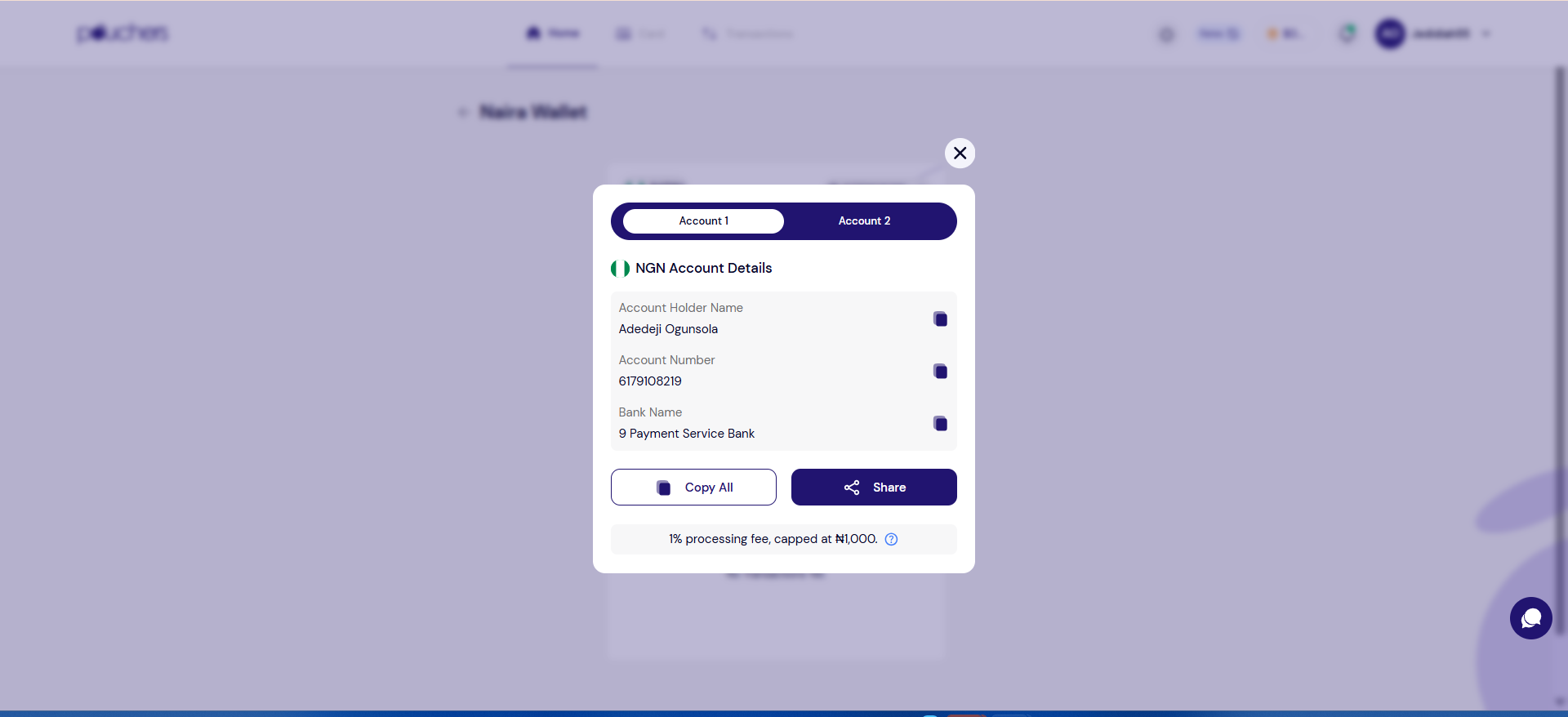
Top up your naira wallet or your dollar wallet; you will see the exchange rate before you confirm.
Step 4: Create your card
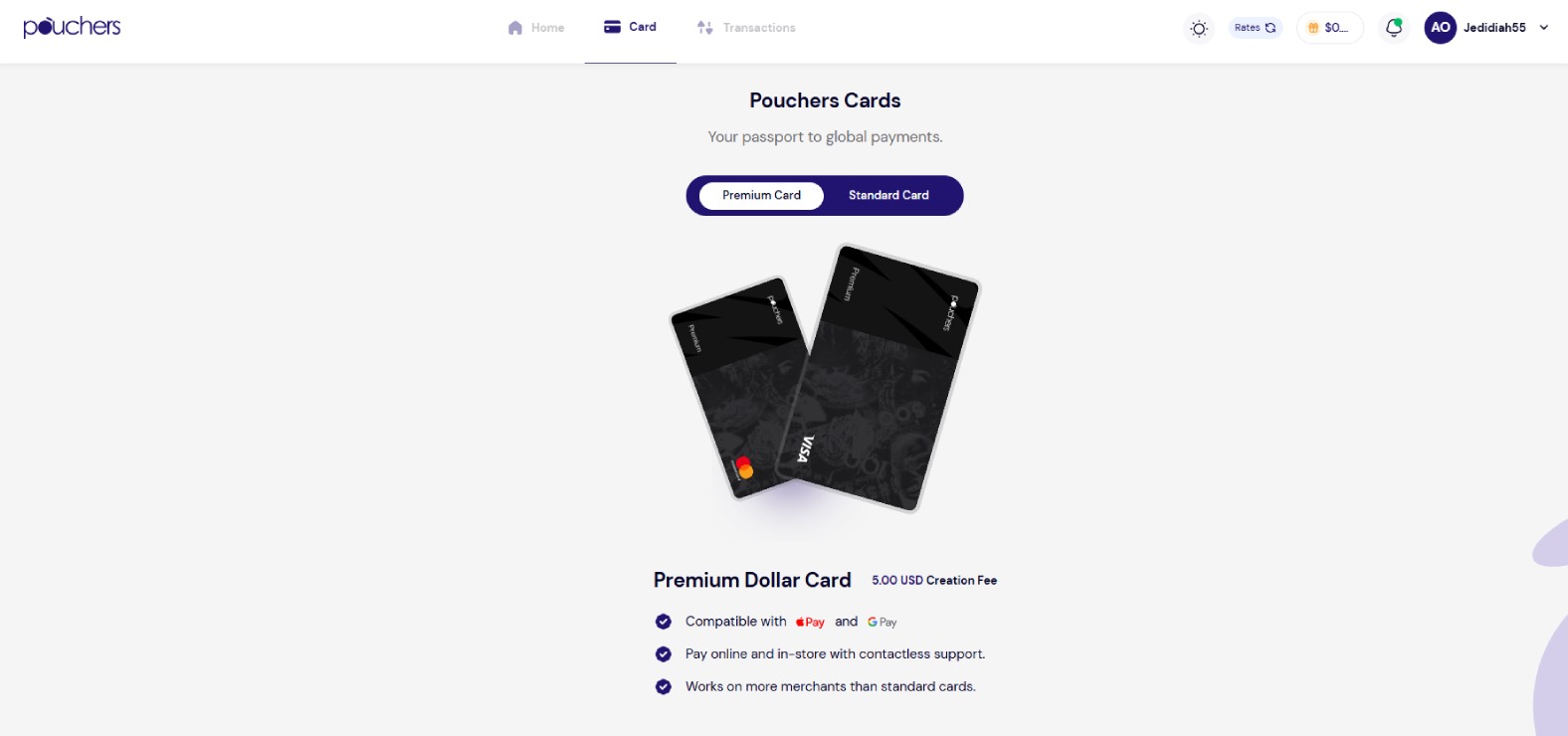
A one-time $2 fee for Standard, or $5 for Premium if you also want Apple Pay and Google Pay.
Step 5: Add the card at checkout
Paste the card number, CVV, and expiry into Spotify, Apple Music, or YouTube. Done.
From then on, renewals simply go through. Keep a small balance on the card before your billing date, and your music never stops. One card handles all three services, plus Netflix, ChatGPT, Canva, and anything else you pay for monthly.
Why Nigerian Bank Cards Get Declined on International Platforms
Four things go wrong most often:
- International payment limits: Many Nigerian banks cap or suspend international transactions on naira cards, so anything routed through a foreign payment processor can bounce.
- Dollar-billed accounts: If your Apple Music or Spotify account was created in the US region, it bills in dollars, and most naira cards decline dollar charges outright.
- Bank-side risk filters: Banks automatically flag and block certain transactions that look like fraud patterns, even when they aren’t. A recurring monthly charge to a foreign company like Spotify can trigger this, since it resembles the kind of repeated, unauthorised charges banks watch for. This can happen even if your account has more than enough funds to cover your subscription
- Card type: Some Verve and virtual Naira cards aren’t accepted for recurring billing at all, because they lack the tokenisation or international-network support that subscription platforms require to store your card details and charge them automatically each month.
Payment sorted. Now for the part that depends entirely on you.
Spotify vs Apple Music vs YouTube Music: Who Each One Is For?
Choose Spotify if you:
- Want new music found for you rather than by you
- Listen across several devices: speakers, car, laptop, console
- Keep podcasts and music in one place
- Share playlists with friends regularly
Choose Apple Music if you:
- Care about how music actually sounds and own decent headphones
- Are splitting a plan with family or flatmates, where ₦1,800 for six is unmatched
- Are a verified student, at ₦550 monthly
- Already live inside the Apple ecosystem, or bundle through Apple One
Choose YouTube Music if you:
- Listen to Nigerian music that never reaches the big streaming platforms
- Want live sets, DJ mixes, freestyles, and remixes alongside studio releases
- Already watch enough YouTube that ad-free video is worth paying for anyway
- Search for songs by humming or half-remembered lyrics
Choose two if you: Run Apple Music Family for the household and keep YouTube Music Premium for everything Apple doesn’t stock. Roughly ₦3,100 monthly covers six people and closes nearly every gap in Nigerian music. That combination is the quiet power move, and almost nobody makes it.
One more thing worth saying out loud: Boomplay and Audiomack exist; they’re built for African listeners, and Audiomack’s free tier is genuinely usable. If your listening is almost entirely Nigerian, start there before paying anyone. But once your playlist crosses borders, and for most people it does, the global three pull ahead on catalogue depth, offline reliability, and device support. Which is exactly when the payment question stops being optional.
Frequently Asked Questions
1. Do I need a VPN to listen to Spotify, Apple Music, or YouTube Music in Nigeria?
No. All three run official Nigerian services with naira pricing and local playlists. A VPN adds nothing, and it can actively hurt you, since platforms increasingly cancel subscriptions they believe were signed up from the wrong region.
2. Which streaming service consumes the most mobile data at maximum quality?
Apple Music, by a wide margin, if you turn on Hi-Res Lossless. Standard streaming is comparable across all three: roughly 144 MB per hour on Spotify at 320 kbps, and around 115 MB per hour on Apple Music and YouTube Music at 256 kbps. Switch Apple Music to Hi-Res Lossless, though, and an hour can swallow several gigabytes. If you stream on mobile data, open Apple Music’s settings and cap cellular streaming at High Quality, then save Lossless for Wi-Fi.
3. How do I transfer my saved playlists from one streaming service to another?
Use a transfer tool like Soundiiz, TuneMyMusic, or FreeYourMusic. You sign in to both services, pick the playlists, and the tool rebuilds them on the new platform, usually in minutes. Free tiers handle a limited number of playlists per transfer, which is enough for most people. Expect a few tracks to go missing; anything exclusive to one platform can’t follow you.
4. Can I use the Pouchers Virtual USD card to pay for a US-region Apple ID or Spotify account?
Yes. That’s exactly the scenario a dollar card solves, since a naira card usually declines dollar-billed accounts outright. Before you switch regions, though, run the numbers. Nigerian pricing is among the cheapest in the world, so a US-region account typically costs several times more for identical music.
5. If I cancel my subscription mid-month, do I lose access to downloaded songs immediately?
No. All three let you keep listening until your paid period ends, then downloads stop playing. Those files stay encrypted on your device and don’t become ordinary music files after cancellation. Resubscribe within a reasonable window and your library and playlists usually return intact.
Conclusion
Apple Music is the best value. Spotify is the most convenient. YouTube Music is the most complete for Nigerian listening.
If you’re splitting with family or flatmates, Apple Music Family is the clear answer, and the per-person maths isn’t close. If you listen alone, move between devices constantly, and want fresh music surfacing without effort, Spotify earns its ₦1,600. And if half your playlist lives on YouTube already, stop pretending otherwise and pay for the app that actually has it.
Whichever you pick, don’t let a declined card decide for you. Get a Pouchers virtual dollar card, fund it in naira, and pay for any subscription, anywhere. No borders, no bounced payments, no silence.
Download the Pouchers app to start paying for Spotify, Apple Music, and YouTube Music with a virtual dollar card.