








The US dollar has long played a major role in international trade as a common currency for cross-border payments. For Nigerian freelancers with clients abroad, earning in dollars creates an opportunity to save in a high-value currency instead of converting every payment to naira as soon as it arrives.
But landing a US client is only half the plot. You need a reliable way to receive your money, keep it in dollars, and access it when you need it without losing too much to fees. Different clients use different payment methods, so the best way to receive your money depends on how each client pays.
A domiciliary account offers a traditional banking option for receiving international wire transfers and holding foreign currency, while a virtual USD account provides a digital alternative that addresses some of the limitations freelancers face with traditional banking.
In this guide, we compare domiciliary accounts vs. virtual USD accounts, using Pouchers as an example, to help you choose the option that fits your payment needs.
Domiciliary Account vs Virtual USD Account: Side-by-Side Comparison
The table below compares domiciliary accounts and virtual USD accounts, including their fees, supported payment methods, account requirements, and features.
| Factor | Domiciliary Account | Virtual USD Account (Pouchers) |
| Opening process | Branch visit or registration through app | Fully app-based |
| Minimum deposit | $100 (Access Bank), $50-$100 (UBA) | $10 |
| Processing time to open | Instant for Domiciliary Lite via branch (Wema) | Instant |
| KYC | ID, passport photo, utility bill, and 2 references; BVN, valid ID, passport photo | Government ID and selfie |
| US routing number | No personal US routing number | Yes |
| ACH receiving | No personal ACH receiving setup | Yes |
| FedNow receiving | No | Yes |
| Wire receiving | Yes | Yes |
| SWIFT receiving | Yes | No |
| Inbound transfer fee (ACH) | N/A | 0.7% (min $2, max $12) |
| Monthly maintenance fee | Varies per bank | None |
| Conversion fee | Bank FX rate/charges apply | Free |
| Naira withdrawal fee | Bank charges apply | ₦100 |
| GBP/EUR support | Yes | Yes |
| Daily spending card | Dollar Debit Visa/Mastercard (GTBank); USD Mastercard Debit Card on Domiciliary Lite (Wema) | Pouchers Standard and Premium dollar cards |
| Virtual USD card supports Apple Pay / Google Pay? | No (GTBank) | Yes, on Premium card |
| Stablecoin support | No | USDT and USDC |
| Upwork / Fiverr compatible | No | Yes |
| PayPal compatible | No | Supported |
| Security/regulation | Regulated by the Central Bank of Nigeria | KYC (Know Your Customer) and account security controls |
| Best for | SWIFT-heavy payments, holding physical cash, formal bank-backed accounts | US-based clients and platforms, ACH/FedNow speed, free conversion, no branch visit |
What Is a Domiciliary Account?
A domiciliary account is a bank account offered by Nigerian banks that lets you receive, hold, and transfer money in currencies such as US dollars, British pounds, and euros without converting your entire balance to naira.
For freelancers earning in dollars, a dom account provides a way to keep their earnings in USD and receive eligible international wire transfers. However, it does not provide US bank details for receiving domestic ACH payments. Opening one may also require additional documentation, an initial deposit, and a branch visit, depending on the bank.
Pros:
- Keep your dollar earnings until you decide when and how much to convert to naira.
- Receive international payments through SWIFT and transfer dollars between eligible domiciliary accounts at the same or different banks.
- Withdraw physical dollars at a bank branch when needed, subject to cash availability.
- Manage your balance and eligible transactions through your bank’s digital banking channels.
- Choose an account that suits your needs. For example, Wema’s Domiciliary Lite has no minimum opening or operating balance but has limitations that the Plus addresses.
Cons:
- Opening a domiciliary account may require several documents, including a valid ID, passport photograph, utility bill, and reference forms. Some banks also require an in-person visit.
- The initial deposit depends on the bank and account type. Some accounts require $50 to $100 or more to open.
- Standard Nigerian domiciliary accounts do not provide personal US bank details for receiving domestic ACH or FedNow payments. SWIFT transfers typically take 1–5 business days.
- International transfers may incur charges from sending, receiving, and intermediary banks. Access to physical dollars also depends on branch services and cash availability.
- Converting dollars to naira requires an extra step. You can sell your dollars through your bank’s available foreign exchange services or a licensed Bureau de Change (BDC) operator before using the naira locally. The exchange rate offered determines how much you receive.
What Is a Virtual USD Account?
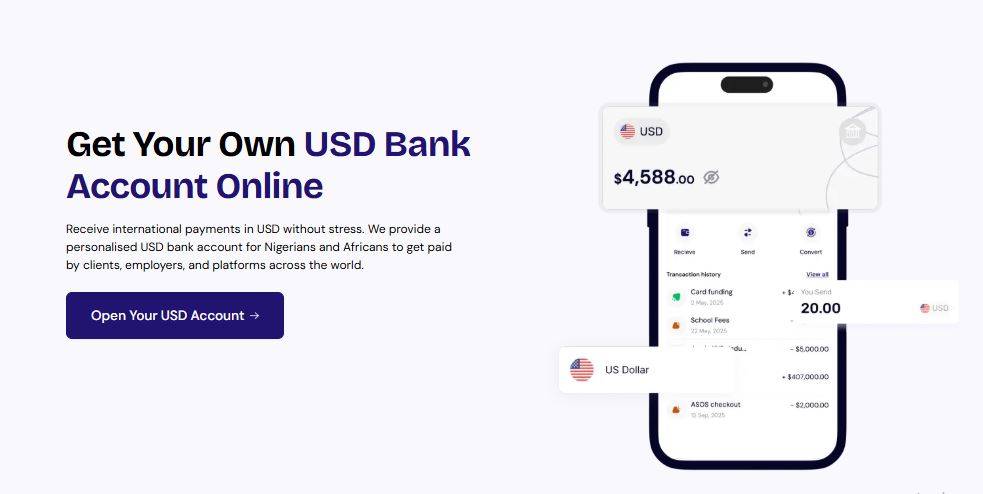
Getting paid by a US client can be more straightforward when you have USD bank account details instead of relying on an international wire transfer. A virtual USD account provides those details through a fintech platform like Pouchers, which lets you receive eligible payments from US clients.
Through Pouchers, you can receive eligible ACH and FedNow payments and hold USD in your account. The platform also offers a stablecoin wallet and a virtual dollar card that users can create and fund using their USD balance.
Pouchers USD account requires a $10 minimum deposit and has no monthly maintenance fee, though eligible ACH transfers incur a 0.7% fee, with a $2 minimum and $12 maximum.
Download the Pouchers app from the Google Play Store or App Store to get create a USD bank account.
Pros:
- Receive eligible US payments through ACH, FedNow, and wire transfers using your personal US account details, including your account and routing numbers. FedNow payments can arrive within seconds.
- Open and manage the account online using a government-issued ID and selfie, without visiting a physical bank branch.
- Convert USD to naira and other supported currencies in the app without a separate currency-conversion fee, then transfer naira to a Nigerian bank account for ₦100.
- Receive payments from platforms such as Upwork, Fiverr, Deel, Toptal, and Contra.
- Use a virtual dollar card for international online purchases, subscriptions, and other eligible payments.
Cons:
- Cannot receive international SWIFT transfers.
- ACH and FedNow deposits attract a 0.7% receiving fee, subject to a $2 minimum and $12 maximum.
- Must complete identity verification with a government-issued ID and selfie before activating the account.
- Receiving payments from freelance platforms depends on the platform accepting the account details and the specific payment method.
What Happens to a $1,000 Payment? Domiciliary Account vs Pouchers USD Account
Let’s say a Nigerian freelancer receives $1,000 from a US client. Both providers use an exchange rate of ₦1,350 per dollar, and the freelancer converts the payment to naira before transferring the proceeds to a Nigerian bank account.
For the domiciliary account, this comparison uses UBA’s Freedom Savings Domiciliary Account. For Pouchers, it uses an incoming ACH payment, which attracts a 0.7% fee, subject to a $2 minimum and $12 maximum.
The comparison assumes the receiver bears any applicable transfer charges, including intermediary bank fees.
| Cost or step | UBA Domiciliary Account | Pouchers USD Account |
| Payment sent | $1,000 | $1,000 |
| Receiving fee | $25 SWIFT/intermediary charge | $7 ACH fee |
| Balance after receiving fee | $975 | $993 |
| Exchange rate | ₦1,350/$ | ₦1,350/$ |
| Naira after conversion (minus conversion fee) | ₦1,316,250 | ₦1,340,550 |
| Local bank transfer/withdrawal fee used | ₦53.75 | ₦100 |
| Final naira received | ₦1,316,196.25 | ₦1,340,450 |
From the calculations above, the freelancer receives ₦24,253.75 more through Pouchers. The UBA figure reflects a $25 deduction for recipient-borne SWIFT and intermediary charges, although the actual amount may vary depending on the transfer route.
Domiciliary Account vs. Virtual Dollar Account: Which Should You Use?
Receive payments from US clients, Upwork, Fiverr, or Deel? Choose Pouchers
Pouchers USD account gives you US account details, including an account number and routing number, for eligible payments from clients abroad. You can receive supported ACH deposits and use the balance for eligible online payments or convert it to naira. Dom account doesn’t provide the details you need for such payments.
Want to convert naira to dollars without sourcing cash or visiting a bank branch? Choose Pouchers
Buying physical dollars to fund an international payment can involve finding a seller and agreeing on an exchange rate. With Pouchers, you can manage your USD balance and convert between supported currencies through the app. This is useful if you pay for software subscriptions, digital advertising, or other services billed in dollars.
Want to receive USD through ACH or FedNow? Choose Pouchers
A US client may prefer to pay through ACH rather than arrange an international wire transfer. Pouchers supports eligible ACH and FedNow deposits through its US account details. ACH payments typically take one to three business days, while eligible FedNow transfers can settle within seconds. A Nigerian domiciliary account does not provide the personal US routing details required for domestic ACH or FedNow receiving.
Want to receive dollars and spend them online with a virtual dollar card? Choose Pouchers
You can use your Pouchers USD balance to fund a Pouchers virtual dollar card for eligible international purchases, including online subscriptions and digital services. The Standard card costs $2 to create, while the Premium card costs $5 and supports Apple Pay and Google Pay for compatible payments.
Want to open an account remotely with a $10 minimum deposit? Choose Pouchers
Pouchers lets you complete account registration online, without travelling to a bank branch. Its account setup uses identity verification, including a government-issued ID and a selfie. If you are comparing the best dollar account for freelancers in Nigeria, the initial funding requirement is an important factor.
Need SWIFT transfers or want to hold physical cash? Choose a domiciliary account.
A domiciliary account may suit you better if your clients pay through international bank wires or need to send a SWIFT transfer to Nigeria. It also gives you a way to hold foreign currency with a Nigerian bank and withdraw physical dollars at a branch, subject to the account’s terms and cash availability.
How to Open a Virtual USD Account With Pouchers
Step 1: Download the Pouchers app and sign up for an account.
Step 2: Open the USD Wallet, select the Fiat tab, and tap Activate Wallet.
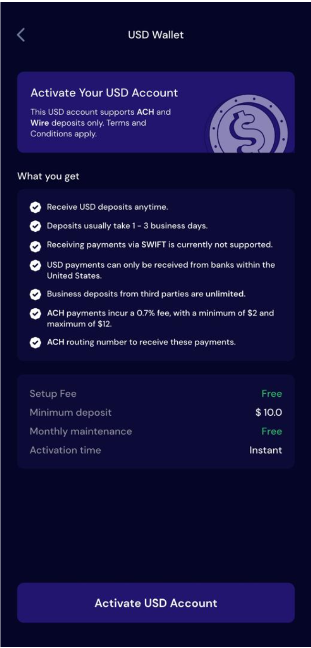
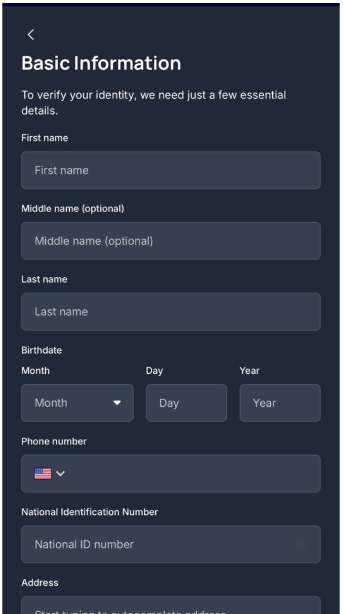
Step 3: Enter your personal details, upload a valid government-issued ID, and take a selfie to complete verification.
Step 4: Once your account is activated, access your account name, account number, routing number, bank name, and bank address.
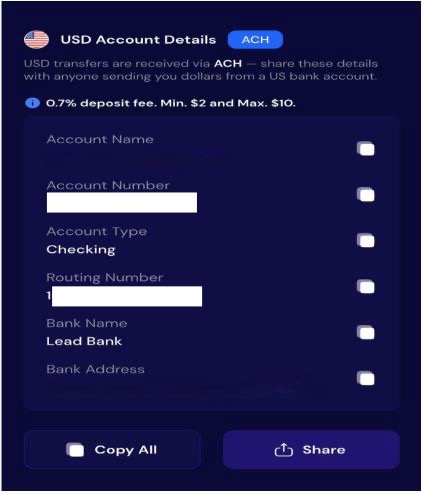
Step 5: Share your account details with clients or add them as a payout method on supported freelance platforms.
Step 6: Receive and hold dollars, convert your balance to naira in the app, or fund a Pouchers virtual dollar card for eligible payments.
Frequently Asked Questions
1. Can I have both a domiciliary account and a virtual USD account?
Yes. You can use both accounts for different purposes. A domiciliary account handles international SWIFT transfers and physical dollar withdrawals, while a virtual USD account such as Pouchers supports eligible US domestic payments and in-app currency conversion.
2. Can I receive freelance payments through a virtual USD account in Nigeria?
Yes. The Pouchers USD account provides US bank details for receiving eligible payments through ACH and other supported methods. You can use these details with platforms such as Upwork, Fiverr, and Deel, subject to each platform’s payment requirements.
3. Which account is better for receiving a US salary?
A virtual USD account such as Pouchers is suitable if your employer pays through supported US domestic payment methods such as ACH. If your employer sends salaries through international SWIFT transfers, a domiciliary account is the appropriate option.
4. What is the cheapest way to receive dollars in Nigeria as a freelancer?
The Pouchers USD account is a cost-effective option for receiving eligible freelance payments through ACH. The receiving fee is 0.7%, subject to a $2 minimum and $12 maximum. There is no monthly maintenance fee, so you can receive payments without recurring account charges.
5. Which is better, a domiciliary account or a fintech USD account?
A fintech USD account such as Pouchers is the more convenient option for freelancers who receive payments through US domestic payment methods, convert dollars to naira in an app, and want a virtual dollar card. A domiciliary account, on the other hand, is more suitable if you need SWIFT transfers or physical dollar withdrawals.
Conclusion
The choice between a domiciliary account and a virtual USD account depends on how you receive payments and how you want to use your earnings. For Nigerian freelancers who receive eligible US payments, Pouchers offers US account details, in-app USD-to-naira conversion, and a virtual dollar card, all without a bank branch visit or monthly maintenance fee. A domiciliary account remains useful if you receive SWIFT transfers or need access to physical dollars.
[Download the Pouchers app to get USD bank account]
Source: